
AI PRODUCTS 4 MIN READ
Wellness app personalization: explain why this, why now.
Personalization becomes easier to trust when the recommendation has an understandable reason. A wellness app should help people choose an appropriate next action while keeping them free to correct the suggestion or explore alternatives.
 AnnaFounder, Asol DesignPublished
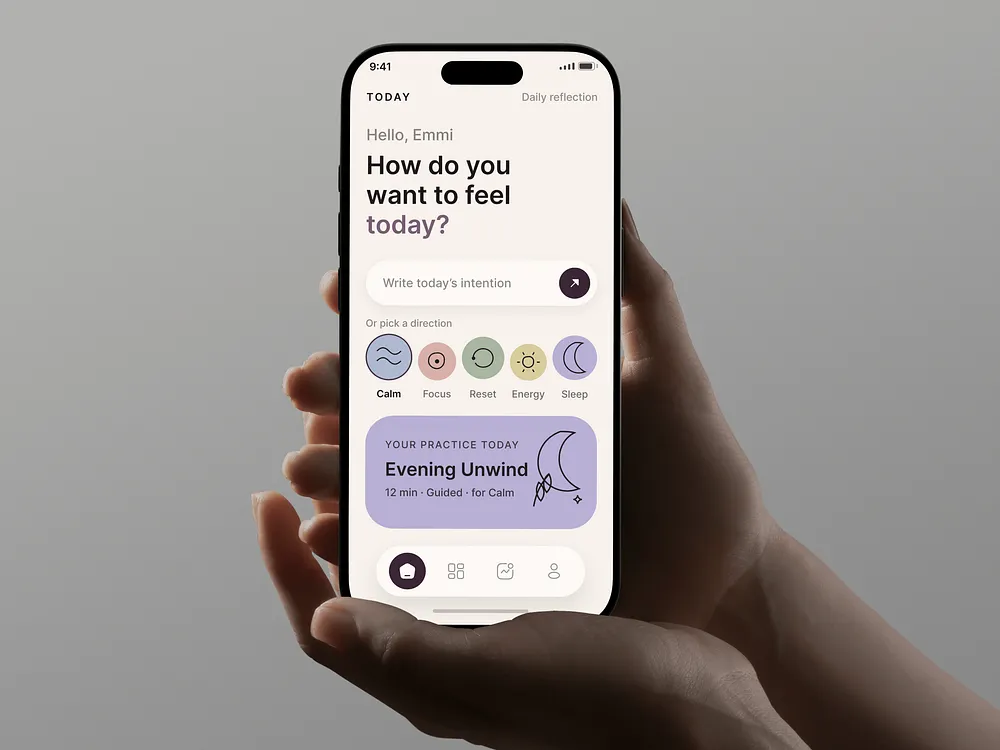
Reduce the decision the user came to avoid
A large library is useful to someone who knows what they want. A person opening a wellness app with little time or energy may need help choosing. Treat those as separate entry modes rather than forcing everyone through the same catalog.
My Luma design exploration places a suggested practice before the full discovery experience. The wider product question is what the app actually knows about the moment: available time, a stated preference and previous choices are different types of evidence.
Use the smallest amount of context that changes the recommendation. If an answer does not affect what happens next, reconsider whether it belongs in the first session. A long questionnaire can undermine a promise of immediate simplicity.
Explain the signal without inventing certainty
A useful explanation refers to information the person recognizes. For example: You chose a short session and a quiet focus. That is different from asserting that the app understands someone’s mental state.
Write explanations from the actual recommendation logic. If the product is using a simple preference rule, the interface should not imply a deeper assessment. If data is limited, offer a clear starting option and invite adjustment.
Avoid presenting engagement predictions as health judgments. Product feedback can describe whether a session felt relevant or easy to begin. It does not, by itself, establish a clinical outcome or make the app a diagnostic service.
Keep correction close to the recommendation
The first suggestion will sometimes be wrong. A user may have less time than expected, dislike the audio or want a different pace. Make those corrections possible before asking them to abandon the recommendation screen.
Offer a small set of meaningful adjustments, such as duration and format, plus an obvious path to browse. Do not make users repeatedly dismiss nearly identical items to teach the product a preference.
When someone changes a choice, clarify whether it applies only now or becomes a saved preference. This prevents a temporary situation from shaping every future recommendation. A simple reset control can be as useful as another personalization feature.
Measure confidence and fit, not just completion
Starting a session tells you the recommendation was accepted. Completing it tells you the session reached its endpoint. Neither fully describes why the person selected it or whether it suited their intent.
Time to choose → recommendation accepted → practice used → optional relevance feedback → next appropriate return.
Use occasional, lightweight feedback rather than turning every session into another survey. Compare people who answer with those who do not, since response patterns can bias the picture. Look at repeated skips and changes of recommendation alongside positive feedback.
State any experiment goal before release. A shorter time to start is useful only if fit and user control remain acceptable. Rushing people into a mismatched session would improve one number while weakening the experience.
Test the moment of uncertainty
A prototype test should include someone who disagrees with the first recommendation. Ask them to find something more appropriate without explaining the controls. Observe whether they understand the reason, can change the relevant constraint and feel able to make their own choice.
Also test an account with no history. The cold-start state should be honest and still useful. A clear default and a small adjustment can work better than an empty personalized area waiting for more data.
These are design hypotheses for evaluation, not reported performance outcomes from Luma. For the later journey, read about helping wellness app users return after a break. For first use, review the first useful result.