
PRODUCT STRATEGY 4 MIN READ
Financial literacy app design: teach decisions, not just definitions.
A financial education app has two responsibilities: make difficult ideas approachable and help learners make better decisions. Engagement is useful only when the experience rewards understanding rather than impulsive activity.
 AnnaFounder, Asol DesignPublished
Start with the learner’s decision
My interest in this category began long before I designed apps. As a child, my father explained business through games and everyday conversations. The ideas became memorable because they were attached to choices, not isolated definitions.
That experience shaped why a financial literacy project for teenagers mattered to me. In the original post, I described completing discovery, rebuilding the product logic and preparing the next stage. This article develops the design principles behind that thinking rather than presenting unmeasured launch results.
Choose a specific learning decision first: compare two options, recognize a trade-off or plan how to reach a goal. “Understand finance” is too broad to guide a first session. A concrete decision gives content, feedback and progression a shared purpose.
Build a practice loop around consequences
A useful loop gives the learner a situation, a choice, a consequence and an explanation. Then it offers another situation where the same principle can be applied. The second attempt is where you begin to learn whether the first explanation transferred.
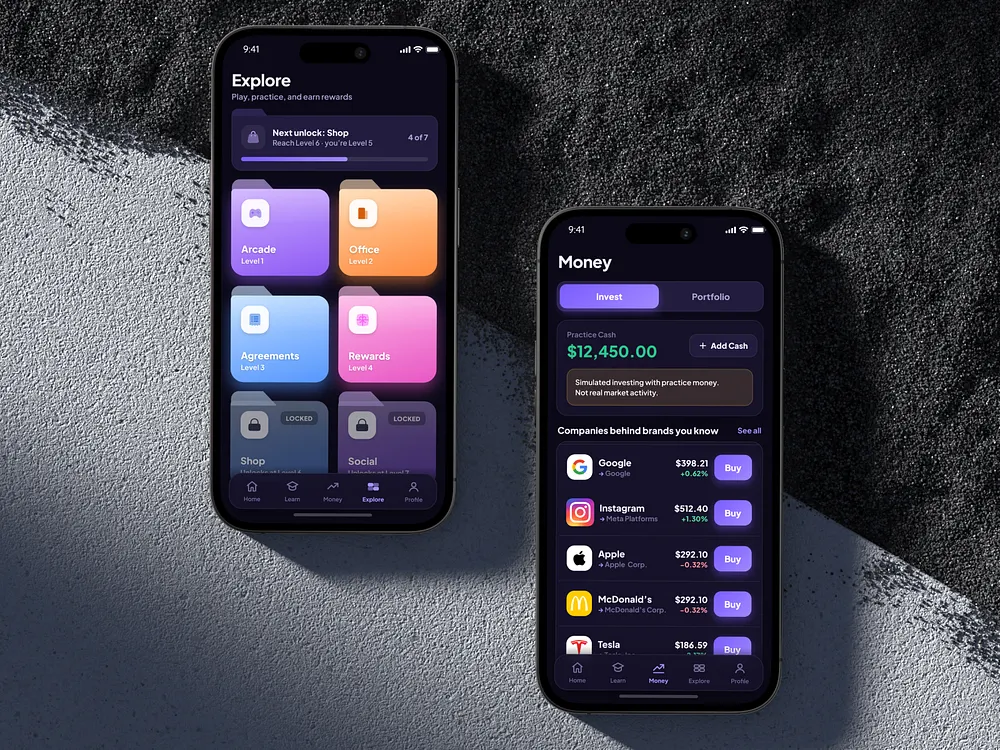
For an illustrative budgeting exercise, give a character a limited fictional budget and competing priorities. Ask the learner to choose, show the consequences and let them revise the decision. The point is to explain trade-offs, not prescribe a personal financial plan.
Keep simulation visibly separate from real money. Label fictional balances and simplified scenarios clearly. A dramatic simulated return should not be mistaken for an expected real-world outcome. If a product introduces actual financial services, that becomes a separate scope with appropriate specialist review.
Use gamification to support judgment
Points and streaks can recognize practice, but their meaning depends on what earns them. Rewarding the number of trades in an investing simulation can encourage exactly the behavior an educational product should ask learners to examine.
Recognize actions that support learning: explaining a choice, noticing a risk, revising an assumption or applying a principle in a new scenario. Make feedback informative enough that a learner can improve without relying on a reward animation.
| Avoid rewarding | Recognize instead |
|---|---|
| Fast tapping through lessons | Understanding a consequence and applying it in a different situation. |
| Repeated speculative actions | Explaining uncertainty and comparing possible outcomes. |
| An unbroken streak at any cost | Returning after a gap and continuing at an appropriate level. |
Playfulness should make the subject approachable. It does not require imitating teen slang or treating every learner as impatient. Test language, pacing and accessibility with the actual age groups the product serves.
Separate the learner, the buyer and the trust decision
The person using the app may not be the person paying for it. A teenager, parent and educational organization can have different reasons to value the same product. Decide which relationship the first version serves.
A learner needs autonomy, clear progress and a useful experience. A parent may want to understand the learning purpose and the boundaries of the product. An institutional buyer may need a different implementation and reporting model. Combining all three without a priority can make an MVP unnecessarily complex.
Be explicit about what information is collected and who can see it. Avoid making social comparison, public rankings or broad data sharing the default source of motivation. Trust belongs in the product model, not only in the last screen before signup.
Measure learning alongside a sustainable business
Track whether learners can make a better decision in a new but related scenario, not just whether they completed the lesson. Pair that with return to meaningful practice, recovery after errors and the ability to explain the underlying principle.
Evaluate monetization separately from learning progress. A paid offer should explain continuing value and who it is for without using anxiety about money or peer status to force a decision. More purchases are not a useful win if the educational experience becomes less trustworthy.
Engagement brings learners back. Learning gives that return a purpose. A viable business model keeps the experience available.
For the first session, see our guide to learning app onboarding. For the wider product, start with one complete learning loop before adding a broad ecosystem of games, content and financial mechanics.