
ACTIVATION 4 MIN READ
Cleaning app gamification starts before the reward.
Cleaning app gamification works best when the underlying task feels clear and achievable. Before adding XP or a mascot, define what needs attention, how much effort it requires and how completion changes the user’s view of their home.
 AnnaFounder, Asol DesignPublished
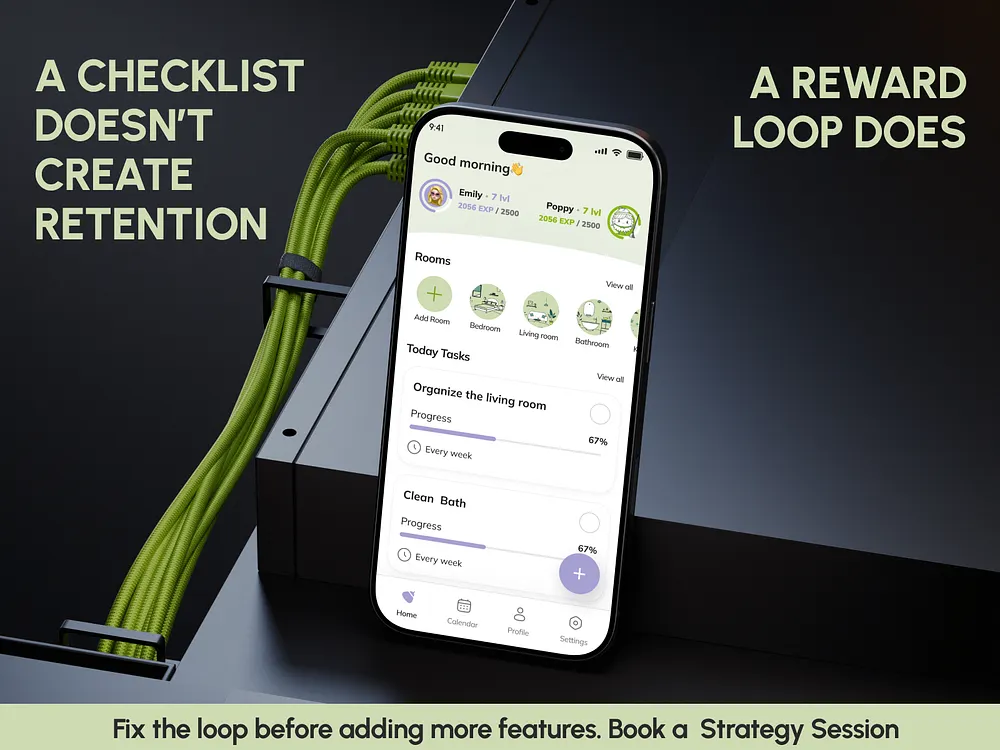
Make the first action smaller than the whole problem
Anna’s November 2025 Poppy notes approached cleaning through room-based UX and small rewards. That is a useful distinction for a habit product: the user may understand the overall goal while still finding it difficult to choose the next action.
A home-wide list mixes different spaces, effort levels and priorities. “Clean the kitchen” can mean several jobs. A more actionable task names a bounded activity, such as clearing one surface, and makes its completion recognizable.
The design hypothesis is that clearer scope reduces hesitation. Test it with the intended users; some will prefer a whole-room routine, while others need tasks that fit a short gap in their day.
Use rooms to organize decisions
Room-based navigation gives a chore app a structure connected to the physical setting. It can help a person understand where they are making progress without requiring them to interpret a long project-management list.
Keep the room view useful at a glance. Distinguish attention needed, a task in progress and work already completed. Avoid letting color do all the work; pair states with clear labels or other readable signals.
Allow the person to adapt the model. Shared spaces, different room names and household routines will not fit one universal template. Start with a manageable default and let users adjust it without rebuilding their entire setup.
Reward real progress with consistent feedback
A reward should acknowledge the action the product exists to support. When a task is completed, update its state immediately, explain the progress and keep the next action available. A short celebration can support this sequence without delaying it.
Decide what XP represents. If it is awarded mainly for opening the app, the system can encourage visits without encouraging home care. If the rules are complex, users may need to learn a second system before they can trust the first.
Keep completion reversible. People tap accidentally, split tasks or change their minds. An undo action protects the accuracy of progress and makes the system more forgiving to use.
The reward is feedback on useful behavior. The useful behavior should remain clear even when the reward animation is removed.
Handle recurring chores without creating a wall of debt
Recurring work is different from a one-time task list. A room that needs attention again does not mean the previous effort disappeared. Preserve a readable history while making the current task state clear.
Give users ways to reschedule, skip or reduce the scope when circumstances change. Explain what each choice does. Quietly moving a missed task into an endless overdue list can make the next session harder to interpret.
Keep this decision separate from reward design. A mascot cannot compensate for a confusing recurrence model. For a deeper look at returning after a gap, see our recovery-loop guide.
Measure task clarity and useful completion
Observe whether new users can identify a suitable task, start it and understand the completion state. Track first-task completion and subsequent routine use with a clearly defined cohort. Treat self-reported task completion as an app signal, not proof that a household outcome occurred.
Ask what the room view and rewards mean to people. If users cannot explain the progress system, more visual polish may amplify confusion. If they understand it but cannot find a task that fits their time, revisit task scope.
A strong cleaning app supports an everyday decision: what can I reasonably do now? Gamification earns its place when it reinforces that answer.